Gardemagne Adventurer Guild
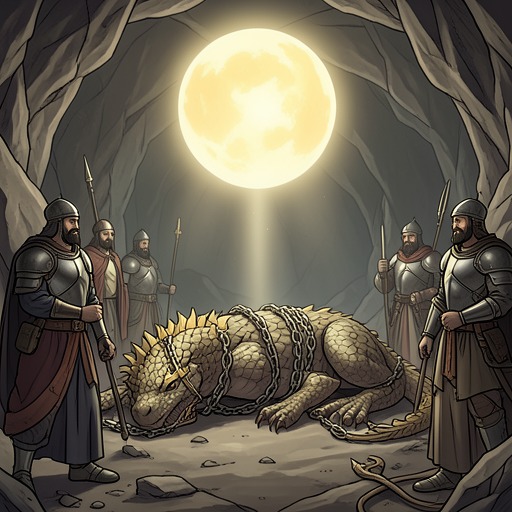
Vainqueur the DragonThe Gardemagne Adventurer Guild is the region’s principal intermediary between clients seeking dangerous work and adventurers or mercenaries willing to perform it. Its decisive importance lies in the collision between ordinary institutional procedure and the extraordinary case of Vainqueur Knightsbane: a great dragon who cannot read the local language, threatens the guild’s staff, and nevertheless enters its system through forms, signatures, rankings, and recognized contracts.
Nature and Administration
The guild operates through a recognizable administrative division of labor. Charlene, its chief of staff and receptionist, explains that she manages paperwork and requests on behalf of the Gardemagne Adventurer Guild, receives requests from clients, and distributes both the assignments and their rewards to adventurers and mercenaries who accept them. The guildhall therefore functions not merely as a meeting place but as a clearinghouse for labor, information, risk, and payment.
That administrative structure is embodied in its written request board. When Vainqueur Knightsbane demands the assignment that brought Victor Dalton to the area, Charlene reads aloud a commission from Louise de Carabas: a reward of one thousand gold pieces for recovering the family’s prized Silver Rapier, reportedly held by goblins in the Albain Mountains. The request includes a drawing of the sword, showing how the guild packages a private loss into a standardized, actionable contract.
Vainqueur Knightsbane and Victor Dalton
The guild’s procedures are tested when Vainqueur Knightsbane arrives with Victor Dalton. Vainqueur cannot read the language even though he can speak it, and he treats communication with humans as a task for a minion rather than a personal obligation. Victor therefore acts as interpreter, intermediary, and negotiator, while Charlene attempts to preserve the appearance of normal business under the threat posed by the dragon.
The encounter becomes explicitly coercive when Vainqueur declares that Charlene is beginning to sound like food. Understanding the implied danger, she produces a large pile of paperwork and proposes registering Vainqueur and Victor as a new adventurer company. Vainqueur responds by promoting Victor to chief of staff and living signature, assigning him responsibility for managing the paperwork on the dragon’s behalf. The guild’s demand for signatures thus reshapes Victor’s position: his service is no longer only that of a subordinate or interpreter, but also that of the company’s administrative instrument.
The registration also produces an unexpected systemic reward. Victor gains a level in the Monster Squire Class for becoming the chief enforcer of a mighty dragon, receiving increases to health, stamina, strength, vitality, skill, agility, intelligence, charisma, and luck. The guild does not create this class directly, but its institutional recognition helps turn the bizarre relationship between dragon and human into a legible role within the Class System.
Rankings, Recognition, and Institutional Caution
The guild uses rank plates to classify adventurers, but Vainqueur’s presence exposes the limits of that classification. After the death of Ogron the Ogre, the guild upgrades Vainqueur and Victor to copper-rank adventurers. The decision is described as due process rather than confident judgment: the guild does not know how to handle a dragon and continues with its normal procedure while waiting for King Gardemagne or the Shining Crusade to settle the matter.
That hesitation persists after Furibon’s destruction. The guild recognizes Vainqueur Knightsbane and his human partner as an adventurer company, plates included. By ordinary advancement logic, the company should be upgraded to gold rank after destroying Maure’s general, the lich Furibon. Yet the political danger of the Euskal fiasco may lead the guild to choose the safer iron or bronze designation instead. The episode reveals a gap between technical qualification and institutional legitimacy: the guild can acknowledge accomplishments, but it may moderate their official consequences when recognition threatens wider political stability.
Quests, Monsters, and Expanding Scale
The guild’s original model assumes that adventurers are people who accept commissions against conventional dangers. Vainqueur and Victor gradually repurpose that model for monster organization. Victor is ordered to open a shop selling junk, monster parts, and corpses so that waste can be converted into money for Vainqueur’s hoard. At the same time, he must prepare Vainqueur’s class progression and train the Kobold Rangers, turning the adventurer company into a hybrid of business, military command, and administrative institution.
The same expansion appears in recruitment for the war against Furibon. Vainqueur observes a line of applicants outside the orchard, mostly kobolds but also other monsters. Victor reports one hundred kobold applicants and additional inhabitants with class levels above twenty, including a troll, a dryad, and a golem. Although the scene is not simply a guild intake process, it extends the company’s original adventurer logic into a recruitment system capable of selecting, training, and deploying monsters.
The contrast with the guild’s handling of corpses is equally revealing. Victor brings six human corpses and a Manticore to the priest of Mithras and asks whether the church will take them, while Vainqueur expects payment for transporting them. The exchange demonstrates how the company’s practical economy repeatedly crosses institutional boundaries: guild work, monster salvage, religious disposal, and commercial value become entangled around the same bodies.
Legacy and Narrative Significance
The Gardemagne Adventurer Guild begins as a conventional bureaucratic setting, but its procedures become a mechanism for institutionalizing the impossible. A dragon is entered into adventurer records; a human servant becomes a living signature; a family heirloom becomes a posted quest; and a monster company receives rank plates despite political uncertainty. The guild’s power is therefore classificatory rather than heroic: it makes extraordinary actors administratively visible.
Its importance also lies in what happens after that recognition. Vainqueur’s organization grows beyond the guild’s original scale into monster recruitment, commerce, training, and wartime mobilization. Later ventures such as Nethermart, the first fiendish magic-item shop in Outremonde, reflect the same conversion of adventure into organized economic activity, even though Nethermart is not itself a guild branch. The guild supplies the initial template—a request, an agent, a reward, a rank, and paperwork—that Vainqueur Knightsbane and Victor Dalton repeatedly enlarge until it resembles a state, a company, and an army at once.